


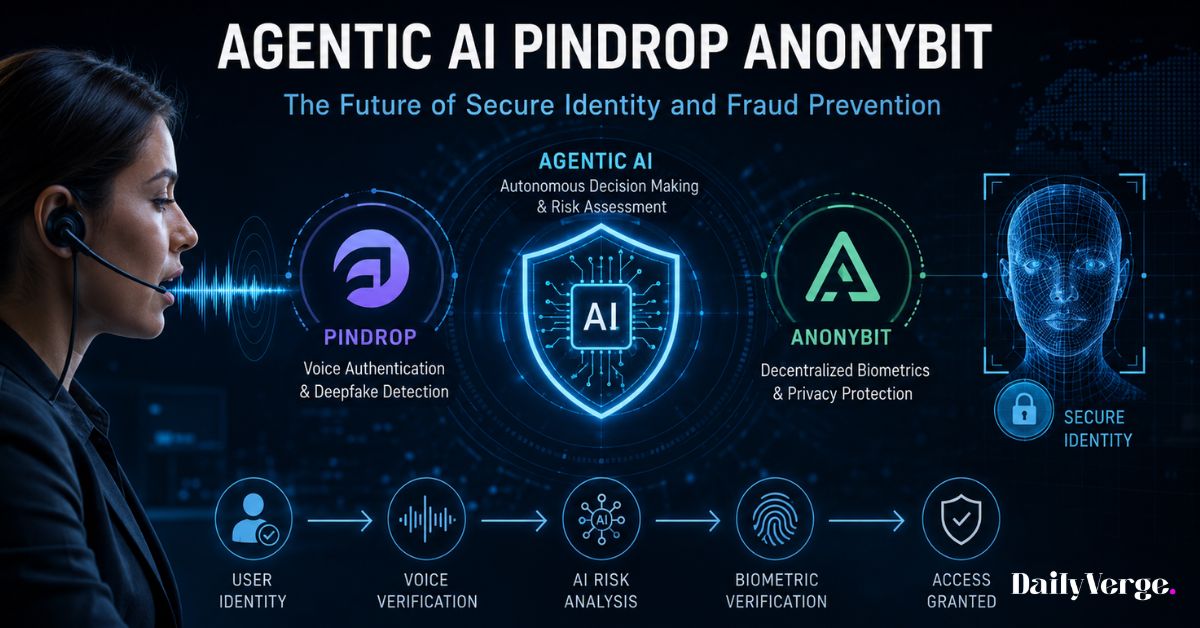
As digital interactions continue to grow across banking, healthcare, government services, and online platforms, organizations face a major challenge: verifying identities while protecting users from increasingly sophisticated fraud attempts. This challenge has fueled interest in agentic ai pindrop anonybit, a concept that combines autonomous decision-making, advanced voice authentication, and decentralized biometric security.
Businesses today are dealing with deepfake voices, account takeovers, identity theft, and synthetic fraud at a scale that was difficult to imagine just a few years ago. Traditional security systems are often reactive, responding only after suspicious activity has occurred. Modern organizations need proactive security frameworks capable of detecting threats in real time while maintaining a smooth user experience. This is where agentic ai pindrop anonybit enters the conversation as an innovative approach to identity verification and fraud prevention.
Understanding Agentic AI
Agentic AI refers to intelligent systems designed to make decisions, complete tasks, and adapt to changing conditions with minimal human intervention. Unlike conventional automation tools that follow fixed rules, agentic systems can analyze situations, evaluate options, and take appropriate actions based on predefined goals.
In cybersecurity environments, these systems can continuously monitor user behavior, identify anomalies, assess risks, and respond to potential threats before they cause harm. This ability makes agentic AI particularly valuable in industries where identity verification and fraud detection are critical.
The growing popularity of agentic ai pindrop anonybit reflects a broader shift toward intelligent security solutions that do more than simply verify passwords or check account activity.
The Role of Pindrop in Voice Authentication
Voice has become one of the most widely used methods of customer verification, especially in contact centers and financial institutions. However, the rise of voice cloning and synthetic speech technologies has created new security concerns.
Pindrop focuses on voice authentication, caller verification, and fraud detection technologies. Its systems analyze hundreds of voice characteristics to determine whether a caller is genuine or potentially fraudulent. This process goes beyond simply recognizing a voice pattern and includes examining signals that may indicate spoofing, manipulation, or synthetic generation.
One of the key strengths associated with agentic ai pindrop anonybit is the ability to combine intelligent decision-making with sophisticated voice analysis. When a suspicious voice is detected, security systems can immediately assess risk levels and trigger additional verification steps.
As voice-based fraud becomes more common, organizations increasingly view advanced voice authentication as an essential layer of protection rather than an optional feature.
Understanding Anonybit and Decentralized Biometrics
Biometric authentication offers convenience and security, but it also raises concerns regarding data storage and privacy. Traditional biometric systems often store sensitive information in centralized databases, creating attractive targets for cybercriminals.
Anonybit approaches this challenge differently through decentralized biometric security. Instead of storing complete biometric records in one location, biometric information is fragmented and distributed across multiple environments. This approach significantly reduces the risk associated with a single point of failure.
The integration of decentralized biometric technologies within agentic ai pindrop anonybit provides an additional layer of protection. Even if attackers gain access to one storage location, they cannot reconstruct a user’s complete biometric profile.
This privacy-focused design aligns with modern security expectations while supporting stronger identity verification processes.
How Agentic AI, Pindrop, and Anonybit Work Together
The real value of agentic ai pindrop anonybit emerges when these technologies operate as a unified security ecosystem.
Imagine a customer calling a financial institution. First, voice authentication technology analyzes the caller’s voice characteristics. Simultaneously, decentralized biometric verification confirms identity without exposing sensitive personal data. An intelligent decision-making system then evaluates the collected information, calculates risk levels, and determines the appropriate action.
If all indicators appear normal, access is granted quickly. If suspicious patterns emerge, the system can request additional verification, limit access privileges, or alert security teams immediately.
This layered approach creates a security model that is both efficient and resilient. Instead of relying on a single authentication method, organizations gain multiple independent verification mechanisms working together.
Why Deepfake Detection Matters More Than Ever
Deepfake technology has evolved rapidly, making it increasingly difficult to distinguish between genuine and synthetic voices. Criminals now use cloned voices to bypass traditional authentication methods, impersonate executives, and manipulate customer service representatives.
The importance of deepfake detection within agentic ai pindrop anonybit cannot be overstated. Advanced voice analysis tools can identify subtle inconsistencies that humans may overlook, helping organizations stop fraudulent activities before they succeed.
As artificial voice generation becomes more accessible, businesses that fail to strengthen their verification systems may face higher risks of financial losses, reputational damage, and customer distrust.
Modern security strategies must therefore include mechanisms specifically designed to detect and respond to synthetic media threats.
Benefits for Businesses and Organizations
Organizations adopting agentic ai pindrop anonybit can experience several significant advantages.
Enhanced fraud prevention is perhaps the most obvious benefit. By combining multiple verification layers, businesses reduce the likelihood of unauthorized access and identity theft.
Improved customer experience is another major advantage. Users can authenticate themselves quickly without remembering complex passwords or completing lengthy verification procedures.
Operational efficiency also increases because intelligent systems can automate many routine security tasks. This allows human teams to focus on complex investigations and strategic initiatives rather than handling every verification request manually.
Additionally, decentralized biometric protection supports privacy objectives and helps organizations address growing concerns about data security.
Industries That Can Benefit from This Technology
Financial institutions are among the primary beneficiaries of agentic ai pindrop anonybit because they face constant threats from fraudsters seeking access to sensitive accounts and financial resources.
Healthcare organizations can use these technologies to protect patient information while ensuring authorized individuals can access medical records securely.
Government agencies may leverage advanced identity verification systems to strengthen digital services and reduce identity-related crimes.
Insurance providers, telecommunications companies, and e-commerce platforms can also benefit from stronger authentication processes that reduce fraud while improving customer satisfaction.
As digital transformation continues, demand for secure identity solutions is expected to grow across virtually every industry.
Challenges and Considerations
Although the potential benefits are substantial, organizations must also address implementation challenges.
Integrating advanced security technologies into existing systems may require significant planning, investment, and technical expertise. Employee training and customer education are equally important for successful adoption.
Privacy regulations and compliance requirements must also be considered carefully. Businesses need transparent policies that explain how authentication data is collected, processed, and protected.
Another consideration is balancing security with user convenience. Excessive verification requirements can create frustration, while insufficient security may increase risk exposure.
Successful deployment depends on finding the right balance between protection, usability, and operational efficiency.
The Future of Identity Verification
The future of digital security is moving toward intelligent, adaptive, and privacy-focused solutions. Passwords alone are no longer sufficient in an environment where cyber threats continue to evolve rapidly.
The growing interest in agentic ai pindrop anonybit demonstrates how organizations are exploring more comprehensive approaches to identity management. By combining autonomous decision-making, advanced voice authentication, and decentralized biometric protection, businesses can create stronger defenses against modern fraud techniques.
As technology continues to advance, these integrated security frameworks are likely to become a standard component of enterprise cybersecurity strategies worldwide.
Conclusion
Digital identity security is entering a new era where traditional authentication methods are no longer enough to address emerging threats. Agentic ai pindrop anonybit represents a powerful combination of intelligent automation, voice-based verification, and decentralized biometric protection designed to strengthen security while maintaining user convenience.
Organizations across banking, healthcare, government, and other sectors are searching for solutions that can combat deepfakes, reduce fraud, and protect sensitive information. By bringing together these complementary technologies, businesses gain a more resilient and future-ready approach to identity verification. As cyber threats continue to evolve, integrated security models such as this may play a central role in protecting digital interactions for years to come.
FAQs
What is agentic ai pindrop anonybit?
It refers to the combination of autonomous decision-making systems, voice authentication technology, and decentralized biometric security for stronger identity verification.
Why is voice authentication important?
Voice authentication helps verify users quickly while reducing the risk of fraud, impersonation, and unauthorized account access.
How does decentralized biometrics improve security?
It distributes biometric data across multiple locations instead of storing it in one database, reducing the risk of large-scale breaches.
Can this technology detect deepfake voices?
Yes, advanced voice analysis systems can identify many signs of synthetic or manipulated audio used in fraud attempts.
Which industries benefit most from this approach?
Banking, healthcare, government, insurance, telecommunications, and e-commerce organizations can all benefit from stronger identity verification.
Read more. technology guides and helpful insights on our website.
