


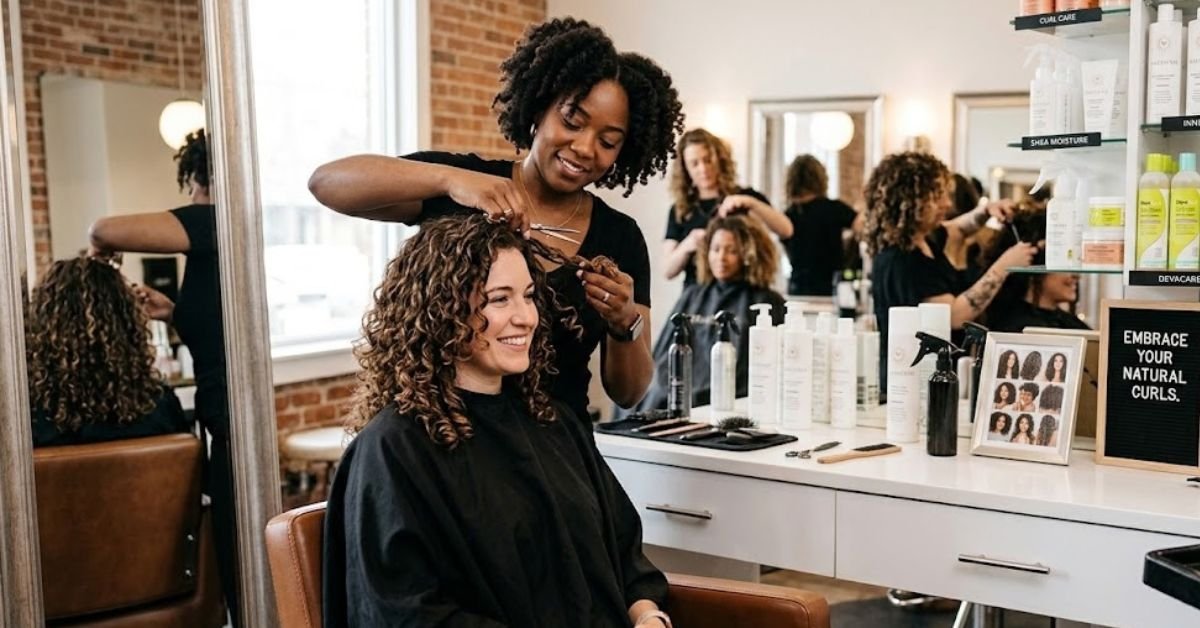
Curly hair has its own shape, movement, texture, and personality. What looks like a simple trim on straight hair can require much more thought when curls are involved. The way hair shrinks, springs back, groups into curl patterns, and responds to moisture can all affect the final result. This is why choosing a stylist who understands natural texture can make such a noticeable difference.
A good curly hair salon does more than shorten the ends. The stylist should consider your curl pattern, hair density, length, face shape, lifestyle, and the way you normally wear your hair. A successful appointment should leave you with a shape that works with your natural curls rather than forcing them into a style that is difficult to maintain.
Whether you have loose waves, defined spirals, tight curls, or coily hair, the right approach starts with understanding what your hair naturally does. Once you know what to look for, finding a suitable stylist and preparing for your appointment becomes much easier.
Why Curly Hair Needs a Different Approach
Curly hair does not always behave the same way when it is wet and dry. Water can stretch curls, while drying allows them to spring back toward their natural shape. This change can affect the apparent length and overall balance of a haircut.
Shrinkage is one of the most important factors a stylist needs to consider. A section that appears long when wet may sit considerably higher after drying. Curl patterns can also vary across one head, with tighter sections around the crown or nape and looser sections elsewhere.
For this reason, a stylist experienced with textured hair usually examines how the curls naturally fall before deciding how much length to remove. The goal is not simply to make every section the same length. It is to create a balanced shape when the hair is actually worn curly.
This texture-first approach can be particularly helpful for people who have previously received haircuts that looked good when wet but became uneven, overly bulky, or much shorter than expected once dry.
What Makes a Curly Hair Salon Different?
A specialist salon generally approaches curls with more attention to their natural pattern. Instead of treating curly hair as straight hair that happens to bend, the stylist considers the movement and structure created by each curl.
The consultation is an important part of this process. A knowledgeable stylist may ask how you normally style your hair, how much time you spend on wash days, whether you prefer volume or definition, and how much length you want to keep.
They may also look at the density of your hair and how different areas behave. Two people can have a similar curl pattern but need completely different cuts because their hair thickness, length, growth pattern, and styling habits are different.
A specialist may also explain what can realistically be achieved during one appointment. This honest discussion is valuable because a photograph can show an attractive style without showing how much daily maintenance is required to recreate it.
Choosing the Right Curly Hair Stylist
Finding the right stylist is often more important than finding the most expensive salon. Experience with curly and textured hair should be one of the first things you investigate.
Start by looking at the stylist’s previous work. Pay attention to photographs showing different curl patterns rather than only straightened or heavily styled hair. If possible, look for examples that resemble your own texture, density, and desired length.
It is also worth asking how the stylist approaches curly cuts. Some professionals prefer working on dry curls, while others use a combination of wet and dry techniques. There is no single method that is automatically correct for every person, so the important question is whether the stylist understands why a particular method is appropriate for your hair.
A consultation can tell you a great deal. A good stylist should be willing to discuss your expectations, explain the proposed shape, and listen to concerns about previous haircuts.
Dry Cutting and Curly Hair
Dry cutting is frequently discussed in curly-hair care because it allows the stylist to see the hair in a more natural state. When curls are dry, the stylist can observe where individual sections sit, how much they shrink, and where volume naturally develops.
That does not mean every curly haircut must be performed completely dry. Depending on the person’s hair and the desired result, a stylist may combine different techniques. The important consideration is whether the method allows the stylist to understand the natural behavior of the hair.
For someone who normally wears their hair curly, seeing the natural shape before major length is removed can make communication easier. You and your stylist can see where the curls are sitting instead of trying to predict the final shape from stretched, wet hair.
If you are interested in a dry cut, ask about the stylist’s experience before booking. You can also ask whether your hair should arrive clean, dry, product-free, or styled in its usual curl pattern.
Understanding Your Curl Pattern
Knowing your general curl pattern can help you communicate with a stylist, although you do not need to become an expert before your appointment.
Wavy hair tends to form softer bends and an S-shaped pattern. Curly hair generally creates more visible spirals or loops, while coily textures can form very tight curls or coils with considerable shrinkage.
Many people also have more than one pattern on their head. The hair around the face may behave differently from the hair at the back, and the crown can have a different density or curl formation from the sides.
Instead of becoming overly concerned with assigning yourself an exact curl category, pay attention to how your hair behaves. Does it become wider as it dries? Does it lose definition when too much product is used? Does it shrink significantly? Does one area curl more tightly than another?
These observations can be more useful during a consultation than simply giving a number or letter to your curl type.
Finding a Haircut That Works With Your Curls
The best haircut depends on more than current trends. Your preferred length, face shape, curl density, and daily routine should all be considered.
Long layers can help create movement while preserving length. Shorter layered styles can provide more volume and definition. A bob can give curls a stronger outline, while longer shapes can create a softer and more flowing appearance.
Face-framing pieces can also be adjusted to work with the way curls naturally sit around the forehead and cheeks. The important point is that the same haircut can look completely different on different curl patterns.
Current styling trends continue to include layered curly shapes, curly bobs, soft shags, shorter textured cuts, and styles that emphasize natural movement. However, a trend should be adapted to the individual rather than copied exactly from a photograph.
When showing a reference image, choose examples with a similar curl pattern whenever possible. A photograph of straight hair or a completely different texture may not give your stylist a realistic picture of the result you can expect.
What to Ask Before Booking an Appointment
A few questions before your appointment can prevent misunderstandings later. You can ask whether the stylist regularly works with your type of curls and whether they have photographs of similar clients.
It is also useful to ask how the haircut will be performed. If you prefer to wear your curls naturally, explain this before the appointment rather than assuming the stylist will know.
Ask whether the service includes washing, conditioning, styling, and drying. Some salons treat these as separate services, while others include them as part of a complete curly haircut.
You should also explain your maintenance routine. If you only want a style that takes a few minutes to manage in the morning, say so. A dramatic haircut that requires extensive styling every day may not be suitable for your lifestyle.
Clear communication is one of the simplest ways to improve the salon experience.
Preparing for Your Curly Hair Appointment
Preparation depends on the salon and the service, so follow the instructions provided when you book. In general, it helps to understand how your hair normally looks and behaves.
Bring a few reference photographs if you have a specific shape in mind. It is even better if the photographs show hair with a texture and length similar to yours.
Be honest about previous chemical treatments, coloring, heat styling, or other processes that may have affected your hair. Your stylist needs accurate information to make sensible decisions about cutting and treatment.
Avoid arriving with excessive product buildup unless the salon specifically asks you to come with your usual styling products. Heavy buildup can make it more difficult to assess the hair and may affect some services.
Most importantly, be clear about what you do not want. If you want to keep substantial length, dislike heavy layers, or do not want excessive volume, say so during the consultation.
Caring for Curls After the Haircut
A good haircut is only part of maintaining healthy-looking curls. Daily care also affects definition, softness, volume, and frizz.
Curly hair can become dry because natural oils do not always travel as easily from the scalp along the bends and twists of the hair. A suitable cleansing and conditioning routine can therefore make a noticeable difference.
Many people with curls benefit from using products designed for their hair’s moisture and styling needs. Leave-in conditioners, curl creams, gels, mousses, and other styling products can all serve different purposes, but using too much product can weigh curls down.
Drying technique matters as well. Excessive handling while curls are drying can disturb curl groups and increase frizz. Some people prefer air drying, while others use a diffuser to speed up the process and control the amount of movement.
There is no universal routine that works for every curl pattern. Your hair’s thickness, porosity, density, climate, and styling preferences all influence what works best.
How Often Should Curly Hair Be Cut?
There is no single schedule that suits everyone. The right timing depends on the haircut, hair growth, condition of the ends, and the shape you want to maintain.
Someone with a precise short style may need more frequent appointments because small amounts of growth can change the overall shape. Someone growing long curls may prefer longer periods between trims.
Instead of following a rigid calendar, pay attention to the condition and shape of your hair. If the ends feel increasingly rough, the shape has lost balance, or styling has become difficult, it may be time to discuss a trim with your stylist.
Regular maintenance can also make it easier to preserve a carefully shaped haircut instead of waiting until the ends are severely damaged.
Curly Hair Coloring and Treatments
Color services require additional consideration when working with curls. Lightening and repeated chemical processing can affect the condition and feel of the hair, so anyone considering color should discuss their hair history with the stylist.
A professional may recommend a particular coloring approach based on the existing condition of the curls. Subtle highlights, balayage, dimensional color, or a complete color change can all produce different maintenance requirements.
Treatments can also be useful when hair needs additional conditioning or moisture. However, not every treatment is appropriate for every person. A stylist should consider the current condition of your hair before recommending a service.
If your curls are already dry, fragile, or damaged, explain this before requesting a major color change or chemical treatment. Protecting the condition of the hair should remain part of the overall plan.
Common Mistakes to Avoid
One common mistake is choosing a stylist solely because the salon is nearby. Convenience is useful, but technical experience matters when you have a texture that requires specialized handling.
Another mistake is focusing only on a photograph. A beautiful reference image can be helpful, but your hair may have different density, length, curl pattern, or shrinkage.
It is also easy to request too many changes at once. If you are uncertain about a dramatic transformation, consider making a smaller change first. This gives you and your stylist an opportunity to understand how your curls respond.
Finally, do not be afraid to ask questions. A professional consultation should be a conversation rather than a situation where you simply sit down and hope for the best.
How to Get Better Results From Your Salon Visit
Good communication can make a major difference. Before the appointment, think about how you want your hair to look on an ordinary day rather than only immediately after leaving the salon.
Tell the stylist how you normally part your hair, whether you like volume, how often you wash it, and how much time you are willing to spend styling it.
If your curls have different patterns in different areas, mention that as well. A stylist can take those differences into account when creating the shape.
Reference photographs are useful, but explain what you like about each image. Perhaps you like the length of one style, the layers of another, and the volume of a third. Giving that information allows the stylist to build a more realistic result around your own hair.
Why the Right Salon Can Change Your Curl Routine
The value of a specialist is not limited to the haircut itself. A good appointment can also teach you more about your own hair.
You may learn how much product your curls actually need, which areas require more moisture, how to preserve definition while drying, and what kind of haircut suits your lifestyle.
Over time, this knowledge can make your routine simpler. Instead of constantly trying new products or copying hairstyles that work for someone else, you can develop a routine based on how your own curls behave.
That is one of the biggest benefits of finding a stylist who understands natural texture. The goal is not to make every curl look identical. It is to create a shape and routine that allow your natural hair to look its best with a realistic amount of maintenance.
Final Thoughts
Choosing a curly hair salon is about finding more than a place to get a haircut. It is about finding a professional who understands how curls move, shrink, respond to moisture, and change from one day to the next.
A suitable stylist will take your individual texture into account, discuss your goals, and explain the techniques that may work best for your hair. Whether you want a small trim, a completely new shape, more definition, or help managing your routine, a thoughtful consultation is a good starting point.
Take time to review a stylist’s curly-hair work, ask questions before booking, and be realistic about the maintenance you are prepared to do at home. With the right approach, a haircut can make your curls easier to manage while preserving the natural character that makes them unique.
FAQs
What should I look for in a curly hair salon?
Look for a stylist with genuine experience working with curly, wavy, or coily textures. Review examples of their work and ask about their cutting and styling approach before booking.
Is a dry cut better for curly hair?
A dry cut can help a stylist see the natural shape and shrinkage of curls. However, the best technique depends on the individual’s hair and the desired result.
How often should curly hair be trimmed?
There is no universal schedule. Short styles may need more frequent maintenance, while people growing their curls may wait longer between appointments.
What should I bring to a curly haircut appointment?
Bring reference photos that resemble your hair and explain what you like about them. It is also helpful to discuss your normal styling routine and previous treatments.
Can curly hair be colored safely?
Curly hair can be colored, but chemical processing should be planned according to the condition of the hair. Discuss previous color, treatments, and dryness with your stylist before making a major change.
