


Reading is more than recognizing words on a page. Every piece of writing is created for a reason, and understanding that reason helps readers connect with the message more effectively. This is where author’s purpose becomes important. Whether you are reading a novel, a news article, a blog post, or an advertisement, the writer has a specific goal in mind. Identifying that goal can improve comprehension, critical thinking, and overall reading skills.
Students, teachers, and everyday readers often encounter the concept of author’s purpose in reading and language arts lessons. Once you learn how to recognize it, you can better understand what the writer wants you to learn, feel, or do. This guide explores the meaning, types, importance, and strategies for identifying author’s purpose in different kinds of texts.
What Is Author’s Purpose?
Author’s purpose refers to the reason a writer creates a particular piece of content. Every article, story, speech, or report is written with a goal. The writer may want to provide information, entertain an audience, persuade readers, or explain a process.
Understanding author’s purpose allows readers to move beyond the surface of the text and discover the writer’s true intention. Instead of simply reading words, readers learn to evaluate why those words were chosen and what message is being communicated.
When readers identify author’s purpose, they become more active and thoughtful participants in the reading process.
Why Is Author’s Purpose Important?
Knowing the author’s purpose helps readers interpret information more accurately. It provides context and allows readers to determine whether the text is presenting facts, opinions, instructions, or entertainment.
For students, recognizing author’s purpose improves reading comprehension and test performance. For adults, it helps evaluate news stories, advertisements, and online content more critically. In a world filled with information, understanding the motivation behind a piece of writing is a valuable skill.
A reader who understands author’s purpose can distinguish between objective information and persuasive arguments. This skill encourages better decision-making and stronger analytical thinking.
The Three Main Types of Author’s Purpose
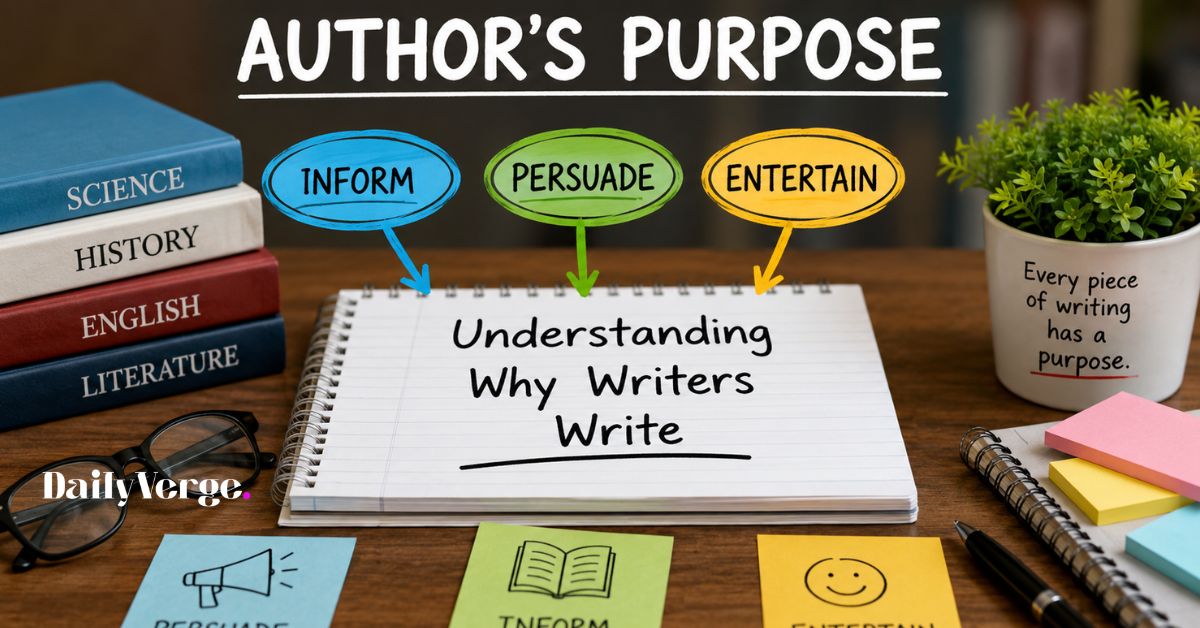
Most educational programs teach three primary categories of author’s purpose. These categories are often remembered using the acronym PIE.
To Inform
When a writer wants to educate readers or provide factual information, the purpose is to inform. Informational texts focus on teaching, explaining, or sharing knowledge.
Examples include:
- Textbooks
- Encyclopedias
- News reports
- Research articles
- Educational websites
These texts typically include facts, statistics, definitions, and explanations. The goal is not to entertain or persuade but to help readers learn something new.
To Persuade
A persuasive text aims to convince readers to think, believe, or act in a particular way. Writers use evidence, emotional appeals, and logical arguments to influence their audience.
Examples include:
- Advertisements
- Editorials
- Opinion articles
- Political speeches
- Product reviews
When analyzing author’s purpose in persuasive writing, pay attention to strong opinions, recommendations, and calls to action.
To Entertain
Entertainment-focused writing is created to engage readers emotionally and provide enjoyment. The writer’s goal is to capture attention through storytelling, humor, suspense, or imagination.
Examples include:
- Novels
- Short stories
- Fairy tales
- Comics
- Poems
In these texts, the focus is often on characters, plots, and creative expression rather than factual information.
Additional Types of Author’s Purpose
Although the PIE model is widely used, many texts serve more specific functions.
To Explain
Some writers aim to make a concept easier to understand. Instruction manuals, tutorials, and how-to guides fall into this category.
To Describe
Descriptive writing creates vivid mental images using sensory details. Travel articles and descriptive essays often use this purpose.
To Express Feelings
Personal essays, memoirs, and journals frequently allow writers to share experiences, emotions, and perspectives.
These additional categories show that author’s purpose can sometimes be more complex than a single label.
How to Identify Author’s Purpose
Finding the author’s intention requires careful reading and observation. Several clues can help readers determine the writer’s goal.
Examine the Language
The words and phrases used throughout a text often reveal its purpose. Factual language usually indicates an informational text, while emotional language may suggest persuasion.
Consider the Structure
A step-by-step format may indicate explanation or instruction. A narrative structure often points toward entertainment.
Look at the Evidence
Writers who include statistics, research findings, and expert opinions are often trying to inform or persuade.
Think About the Audience
Consider who the text is written for. Children’s stories, academic reports, and advertisements each target different audiences and often have different purposes.
Learning to identify author’s purpose becomes easier with practice and exposure to various types of writing.
Common Examples of Author’s Purpose
Real-world examples make the concept easier to understand.
A newspaper article about climate change may aim to inform readers about scientific findings.
A commercial promoting a new smartphone likely seeks to persuade viewers to make a purchase.
A fantasy novel filled with magical adventures is usually designed to entertain readers.
A recipe blog explaining cooking techniques may have the purpose of informing and instructing at the same time.
These examples demonstrate how author’s purpose appears in everyday reading materials.
Author’s Purpose in Fiction and Nonfiction
Both fiction and nonfiction texts have purposes, but they often approach readers differently.
Fiction commonly focuses on entertainment through storytelling, character development, and imaginative settings. However, many fictional works also teach lessons or encourage reflection.
Nonfiction generally emphasizes information, explanation, or persuasion. News reports, biographies, and educational articles often aim to provide knowledge while maintaining credibility.
Recognizing author’s purpose in both forms of writing helps readers appreciate the choices writers make to achieve their goals.
Common Mistakes When Determining Author’s Purpose
Readers sometimes make assumptions without considering all the evidence in a text.
One common mistake is focusing on a single sentence instead of the overall message. Another is confusing the topic with the purpose. For example, a text about healthy eating may inform readers about nutrition or persuade them to change their habits.
It is also important to remember that some texts have multiple purposes. A travel article may inform readers about a destination while entertaining them with engaging stories.
Looking at the entire text provides a clearer understanding of author’s purpose.
How Students Can Improve Their Understanding
Students can strengthen their ability to identify purpose through regular reading practice.
Reading a variety of genres exposes learners to different writing styles and intentions. Asking questions during reading also helps. Questions such as “Why did the writer create this text?” and “What does the writer want me to think or learn?” encourage deeper analysis.
Teachers often use reading passages, discussions, and worksheets to help students recognize patterns associated with different purposes. Over time, these activities improve comprehension and critical thinking skills.
Conclusion
Understanding author’s purpose is one of the most valuable reading skills a person can develop. It helps readers recognize why a text was written, evaluate information more carefully, and engage with content on a deeper level. Whether a writer wants to inform, persuade, entertain, explain, or express ideas, identifying that intention creates a stronger connection between the reader and the message. By practicing this skill regularly, readers become more confident, thoughtful, and effective in their interpretation of all types of writing.
FAQs
What is author’s purpose?
Author’s purpose is the reason a writer creates a piece of writing. The goal may be to inform, persuade, entertain, or explain.
Why is author’s purpose important?
It helps readers understand the writer’s message and improves overall reading comprehension.
What are the three main types of author’s purpose?
The three primary purposes are to inform, persuade, and entertain.
Can a text have more than one purpose?
Yes. Many texts combine purposes, such as informing readers while also entertaining them.
How can students identify author’s purpose?
Students can examine the language, structure, evidence, and target audience of a text to determine the writer’s goal. read more.
