


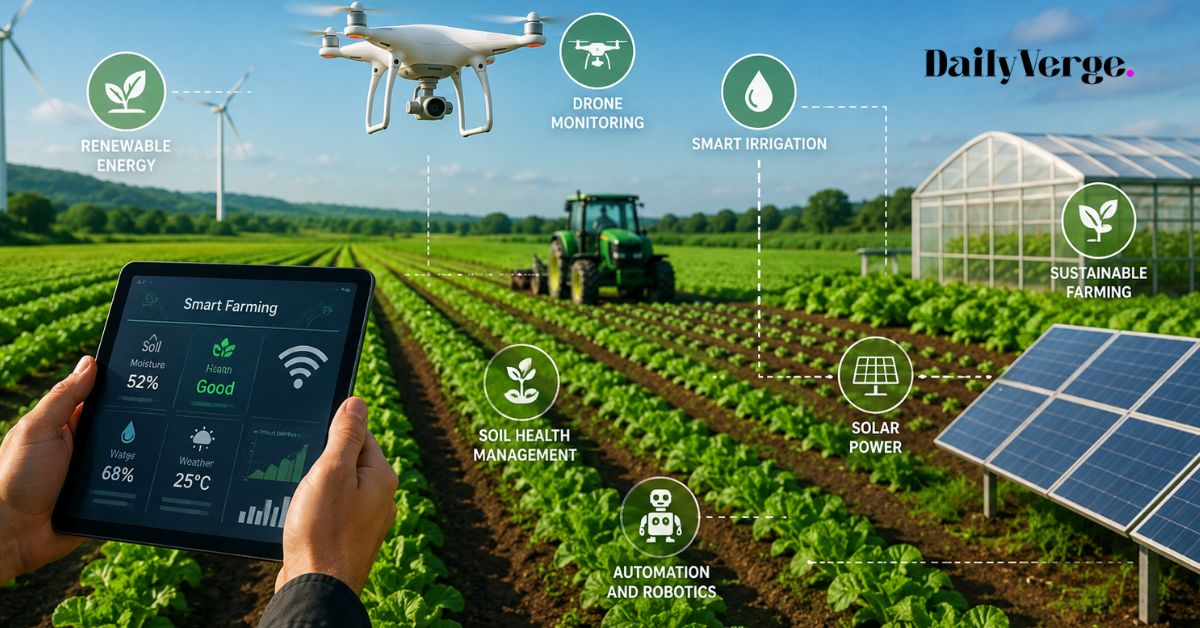
Modern agriculture is going through a major transformation as farmers look for smarter and cleaner ways to grow food. The focus is no longer only on higher yield but also on protecting soil, saving water, and reducing environmental damage. In this changing landscape, what are the best green technologies for farming? This question is becoming more important as climate change, water shortages, and soil degradation continue to affect global food production. Green farming technologies are designed to solve these challenges by combining innovation with sustainability, helping farmers produce more while using fewer natural resources.
Precision Agriculture and Smart Farming
One of the most powerful advancements in modern agriculture is precision farming. It uses GPS systems, sensors, drones, and data analytics to monitor crops and soil conditions in real time. Farmers can apply water, fertilizer, and pesticides only where needed instead of treating entire fields uniformly. This reduces waste and improves crop health. Many experts believe that what are the best green technologies for farming? often begins with precision agriculture because it maximizes efficiency while minimizing environmental impact. It also helps farmers make better decisions based on accurate field data.
Efficient Water Management Systems
Water scarcity is one of the biggest challenges in agriculture today. Smart irrigation systems such as drip irrigation and automated moisture sensors are changing how water is used on farms. These systems deliver water directly to plant roots, reducing evaporation and runoff. Farmers can also use weather-based irrigation scheduling to avoid unnecessary watering. In discussions about what are the best green technologies for farming? efficient water management always plays a central role because it significantly reduces water consumption while improving productivity.
Renewable Energy in Farming
Traditional farming methods rely heavily on diesel and electricity from non-renewable sources. Today, solar panels, wind turbines, and biogas systems are being widely adopted on farms. Solar-powered pumps, for example, allow farmers to irrigate fields without fuel costs or emissions. Livestock waste can be converted into biogas, which can be used for cooking or powering equipment. When evaluating what are the best green technologies for farming? renewable energy solutions stand out because they reduce carbon footprints and lower long-term operational costs.
Organic and Natural Farming Techniques
Another important shift in agriculture is the return to organic methods supported by modern science. Instead of chemical fertilizers and pesticides, farmers use compost, green manure, crop rotation, and biological pest control. These methods improve soil fertility and reduce pollution in water systems. Consumers are also increasingly demanding chemical-free produce, which encourages farmers to adopt sustainable practices. In many discussions about what are the best green technologies for farming? organic farming remains a strong answer due to its long-term environmental benefits and soil restoration effects.
Vertical Farming and Controlled Environment Agriculture
As urban populations grow, traditional farmland is becoming limited. Vertical farming offers a solution by growing crops in stacked layers inside controlled environments. These systems often use hydroponics or aeroponics, which eliminate the need for soil and significantly reduce water usage. LED lighting and climate control systems allow crops to grow year-round regardless of outdoor weather. When exploring what are the best green technologies for farming? vertical farming is often highlighted because it produces high yields in small spaces while using fewer resources.
AI, Robotics, and Automation in Agriculture
Artificial intelligence and robotics are transforming farming into a highly automated industry. Machines can now plant seeds, identify weeds, and harvest crops with minimal human intervention. AI-powered systems also help detect pests and diseases early, reducing the need for chemical treatments. This improves efficiency and reduces environmental harm. Many agricultural researchers include automation when answering what are the best green technologies for farming? because it increases productivity while lowering labor intensity and chemical dependency.
Soil Health and Climate-Smart Practices
Healthy soil is the foundation of sustainable agriculture. Practices such as no-till farming, cover cropping, and crop diversification help maintain soil structure and fertility. These methods also reduce erosion and increase carbon storage in the soil, which helps fight climate change. Farmers are increasingly adopting regenerative techniques to restore degraded land. In modern discussions about what are the best green technologies for farming? soil management practices are essential because they ensure long-term productivity and environmental balance.
Emerging Innovations in Sustainable Agriculture
New technologies continue to reshape farming every year. Innovations such as carbon farming, biochar application, blockchain-based supply chains, and smart greenhouses are gaining attention. These systems aim to increase transparency, improve efficiency, and reduce environmental impact across the entire food production cycle. As agriculture evolves, what are the best green technologies for farming? continues to expand in meaning, now including a wide range of digital and biological innovations that support sustainability on a global scale.
Environmental and Economic Benefits of Green Farming
Green technologies not only help the environment but also improve farm profitability. Reduced water usage, lower energy costs, and optimized fertilizer application lead to significant savings. At the same time, healthier soil and better crop quality increase long-term productivity. Farmers who adopt sustainable practices are also better prepared for climate-related risks such as droughts and floods. This makes modern green agriculture both an environmental necessity and an economic advantage.
Conclusion
The future of agriculture depends on innovation and sustainability working together. From smart sensors and renewable energy to soil conservation and vertical farming, green technologies are reshaping how food is grown around the world. As global challenges continue to increase, what are the best green technologies for farming? is no longer just a question but a roadmap for building a more sustainable and resilient food system.
FAQs
What is green technology in farming?
Green technology in farming refers to eco-friendly methods that reduce environmental impact while improving agricultural productivity.
Why is precision farming important?
It helps farmers use resources more efficiently by applying water, fertilizer, and pesticides only where needed.
How does vertical farming save resources?
It uses less water and land while allowing crops to grow in controlled indoor environments year-round.
What are the benefits of renewable energy in agriculture?
It reduces fuel costs, lowers carbon emissions, and provides sustainable power for farm operations.
Can green farming increase profits?
Yes, it reduces input costs and improves long-term soil health, leading to better productivity and income.
Read more. technology guides and helpful insights on our website.
